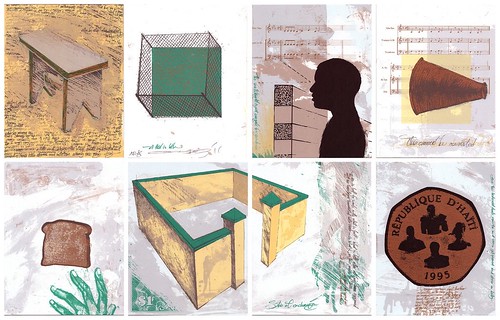
“There is a kind of day that is very grey or brown . . . it is a mood or tone I often feel on a dreary day, waiting for a taxi before it rains or going to some kind of daily routine . . . It’s the experience of being on the street in open space, or just inside ourselves. What do we feel, what do we choose to notice and sense on a given day? It’s about the internal and external landscape of the place as I experience it.”

From "Taking note", by Nicholas Laughlin, in the August 2006 Caribbean Review of Books

Wednesday, February 13, 2008

"Down Diego"

Down Diego

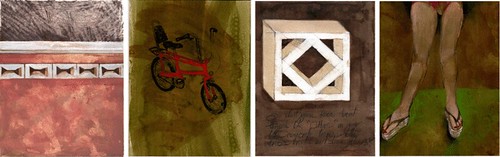
Titles ( L-R) : "D'Vale", "Red Horny Boy Ride", "Starting Blocks" and "Itchy Lawn and Sticky Fingers". "Down Diego" is yet another thread that I just noticed within the group of new drawings. It is another of those works that engage, the unmentionable or unseen - tropical suburbia in the late 60's. I like it because it contradicts much of my usual concerns about the use of the women's bodies within conventional gendered narratives. It carries a recurring theme that I have avoided or deferred for some time now, but this series is not about being rational. It's about sensing rather than censoring. In one of my early texts in the 90's, I heard myself referring to Diego Martin as " that suburban fungus on the landscape" what of this moment from my growing years would create such a reaction / description.

Thursday, October 4, 2007

Dartmouth Sequence

Dartmouth sequence- Little Gestures

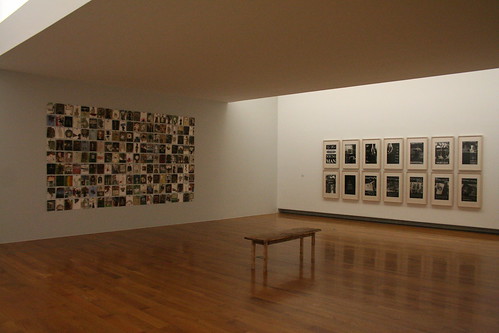
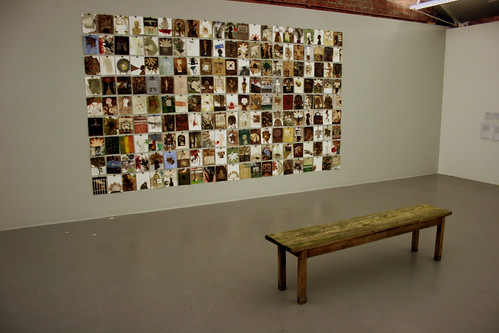
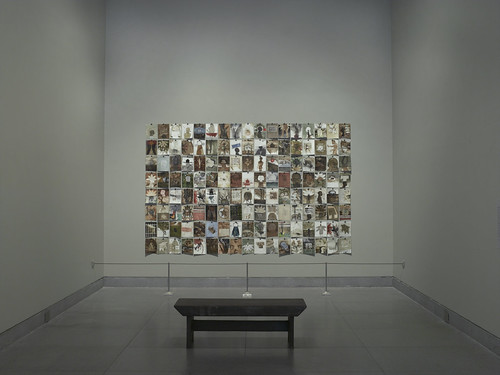
Image of the artist in the Dartmouth College exhibition space by photographer Joseph Mehling. This new group, from the ongoing Tropical Night project, I have called it "little gestures" because the image of the bench dominates and also as it feels a bit lighter in mood and tone than the sequence in New York.

Thursday, August 30, 2007

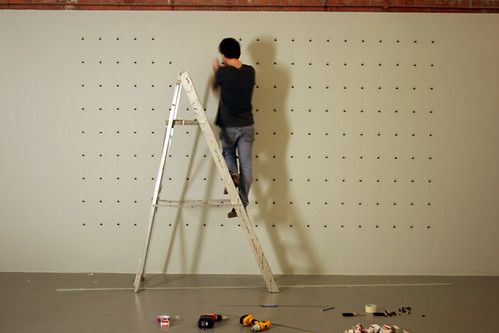
Installing Tropical Night in Brooklyn


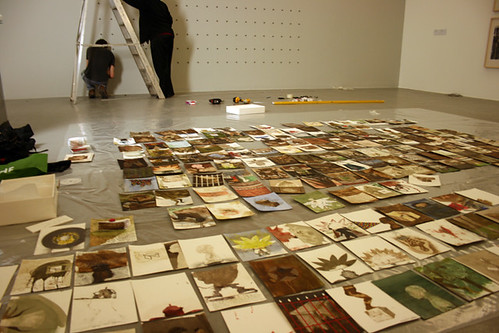
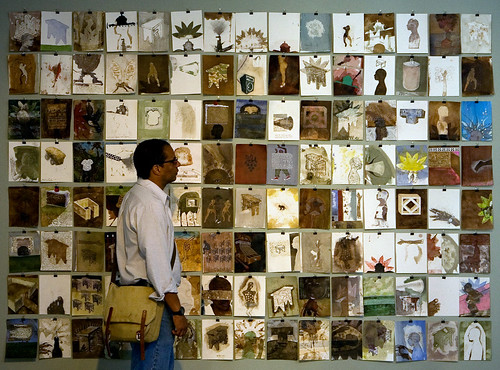
Christopher Cozier installing the Tropical Night drawings at the Brooklyn Museum, August 2007


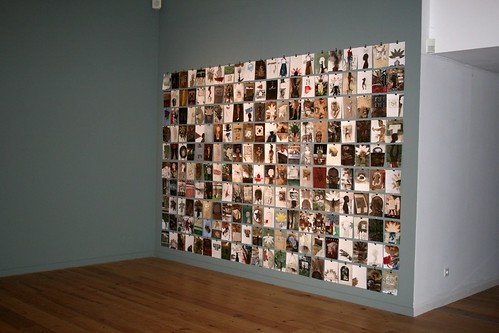
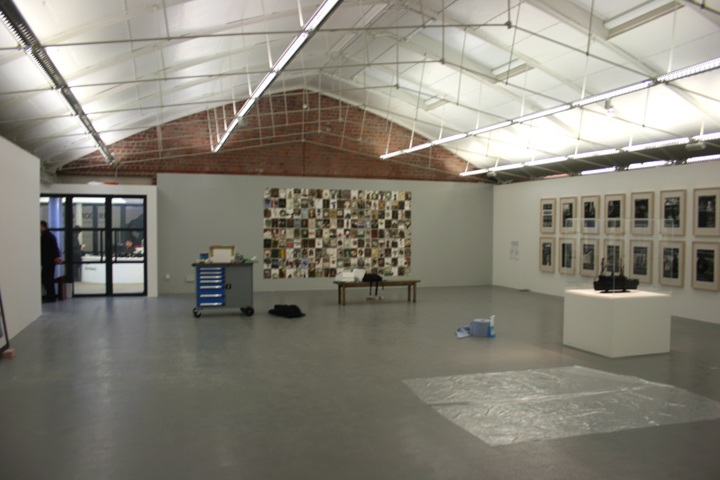
Infinite Island, an exhibition of the work of forty-five contemporary artists from the Caribbean, opens tomorrow at the Brooklyn Museum. It includes an installation of two hundred of the Tropical Night drawings. At the museum blog, curatorial assistant Tamara Schechter describes the process of installing the drawings, which occupy their own small gallery off one of the larger spaces.

Infinite Island installation shot.

Installation shot courtesy the Brooklyn Museum

Wednesday, June 13, 2007

Looking for stories

There is a kind of bibliophile’s parlour game in which you arrange books on a shelf so that the sequence of titles on their spines tells a story.

You might do something similar with the titles of the individual drawings in the Tropical Night series.

Feathered Bat Descending. In the Dance. Hop Skip Jump. Jump Up. Shot Call. Flight.

Coming and Going. Immersed in Explanations. Submerged.

Oxford Journey. Castaway. New World. Making Progress.

A Next Day. Sitting Here Watching. Open Seas. Day In, Day Out.

After the Fire. Crown. Thorns. Bird Stress. Air. The Hills. That Tree. The Hunger.

Another kind of narrative. Another way, perhaps, of not seeing the thing at hand, the marks on the piece of paper before me.

--NL

Tuesday, June 5, 2007

"Brown"

"Brown drawings". That is the name of the folder on my hard drive where I file the Tropical Night scans. Maybe Chris used this term at some point early in our conversations about the drawings. Maybe it was just the first thing that came to mind when I created the folder, more than a year ago--the label that my semi-conscious mind grabbed at to distinguish these from his earlier work.

Many of the drawings are literally "brown", composed largely in washes of sepia ink. Some are not. This is obvious. This is the artist's prerogative of medium. It is also obvious that the "brown-ness" is, more meaningfully, a mood. The dark brown of dried blood--

"the imagery as it unravels always seems to be in this dark, this dark murky space in which we are searching for light...."

--or the weary brown of an old photograph, but not the kind of photo that inspires nostalgia, like an old black-and-white snapshot of a Carnival costume from the 60s or 70s, and looking at it you feel the heat and dust of the moment, the weight of the costume and the stickiness and the headache noise, and you're glad you're not there; it might even be a moment from your own past that you're glad you don't have to relive. Or just a meteorological brown--

"a mood or tone I often feel on a dreary day, waiting for a taxi before it rains or going to some kind of daily routine...."

--a "brown-ness" of spirit familiar to anyone who grew up in the tropics, a "brown-ness" found only in this climate, like a film of dust over the bright blues and greens and yellows that are supposed to be the exemplary colours of the tropical landscape; the "brown" of that "shadowed space that is not between 10 a.m. and 2 p.m. with intermittent clouds", as Chris puts it.

The murky brown of a situation or even a frame of mind when nothing is clear and too many layers of experience, too many kinds of memories and expectations, turn all your thoughts to mud. You stare out the window at a clean blue sky, or you stare down at a clean white page, but all you really see is the brown haze of not having an answer or not knowing what to do next. A brown night on a street in Belmont or Woodbrook. The brown at the bottom of my cup of coffee, when what seemed like the morning's fresh clarity turns out to be the same frustrating fog of last night.

--NL

Monday, June 4, 2007

The writer wonders what the artist thinks.

Wednesday, May 30, 2007

little gestures

camouflage bench

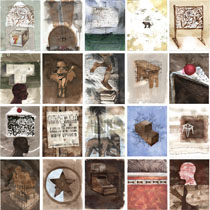
I have been wondering about these little daily gestures and their meaning. I am drawing many little benches over and over. I may be creating another procession or grouping. Each has a name. This one is "camouflage bench." Another one, with guitars, I have called "lyrical bench." How radical are small modest daily gestures. For now they seem to suggest ways to make sense of the world by making things? I like something about the direct or blunt fact-ness of the bench image.
it is a cut-out not an image resting in a space as defined by the paper it is drawn upon....it can then sit or be placed anywhere as a sign.

Monday, May 14, 2007

looking-in sequence

looking sequence

I keep hearing this voice saying “...excuse me - do not let me prevent you from swallowing…” I feel that higher walls and tighter enclosures are really a reflection of a kind of guilt and or social aggression. Perhaps some people have given in or up - they just want to hide and have their pleasures and or privileges? Maybe they cannot help themselves but to have these things and they now see politics as about putting measures in place to protect and preserve the privilege of having…having even minor little things? The phrase "emerging head" sounds so 70's but I like it this "head" that pops up in my work all the time. It suggests being submereged in water or being behind a wall looking in. I think it also reminds me of the way bandits in cowboy movies covered their faces or some of today's revolutionary figures.
C.C.

Thursday, May 10, 2007

one narrative thread

narrative-sequence-1

As I had said, the word “literary” could imply/require a narrative pursuit and that may limit me or demand a purpose or some kind of accountability. I do not really want to have a way through this or an idea of a way. I feel adrift, a bit lost and I am looking for and at signs. I do not want to frustrate the viewer. I am searching for empathy.
But images in sequence – flexible sequences - ones that are not fixed or overly determined feels more expansive. It feels like saying some thing twice or again the following day in another conversation and realizing some connection or what the idea was really about.
I will put forward one thread that I noticed or that just occurred to me while looking at the images. It is not new to my thoughts as someone who grew up here in the 60’s and 70’s though.
The thought of see-through jerseys, gun barrels and bodies has returned yet again. The Baldheaded jersey man operates associatively like some kind of distorted Papa Bois in the ideological forest. There was a temptation to go into the public archives to find that front-page image of the shot young woman on the forest floor but its reshaping and fluidity in memory seemed to be more capable in some way of saying something as well. It could become a way of owning that memory or feeling that I observed in those a little older than myself, then, of youthful dreams - that “Third-World-ism” of the era and in which the term “political disturbance” was used as if what is going around you – the stagnation was a normal or an acceptable or given political operation.
The “open drawers” responds to one columnist’s suggestion that our current political parties are simply opportunistic sieges on the state’s cash register by competing social cliques/groups.
So this “open drawers” seems to fit between two predicaments or characterizations that keep coming up. “Afro-Ophelia” makes a link between the Pre-Raphaelite image of Ophelia in my Nelson Reader, the book through which formal English was conveyed to me, and the front page images of the dailies which showed the dead body of a young woman who was part of a political group called NUFF. The other woman who is called “The Venus of Avianca” or “21 years and Over” brings up another related story of consumption and cash flow as we face yet another “boom.”

C.C.

Tuesday, May 8, 2007

A writer's mode?

I’m looking again at the drawings, and musing over what I can’t help thinking of as the literariness of the whole sequence. I realise that they cast into clearer relief a certain literary quality of Chris’s entire oeuvre. I don’t mean just the fact that he’s an active, voluble practising critic. I don’t mean just that his works on paper, even at their most cryptic, almost always have a strong narrative sense. I don’t mean just that his groundbreaking early work, Conversations with a Shirt Jac, was in effect a soliloquy; or that his sound installations seem to play with elements of performance poetry; or that text--actual writing, the physical shape of words--recurs through his work. I mean--and I’m trying to understand--something about his mode of thought, the way Chris experiences and processes the world; his mode of thought seems essentially that of a writer. He has what I think of as a writer’s intense self-consciousness, a writer’s obsession with putting the world into words to keep the world from disappearing entirely. Drawing is his note-taking, he says, but I’m sure he also has that voice in his head that never stops detailing and describing, converting sensory facts into words and those words into sentences, so that each day is an epic novel of the mundane that will never get written, and memory is a series of inaccurately recalled quotations.

--NL